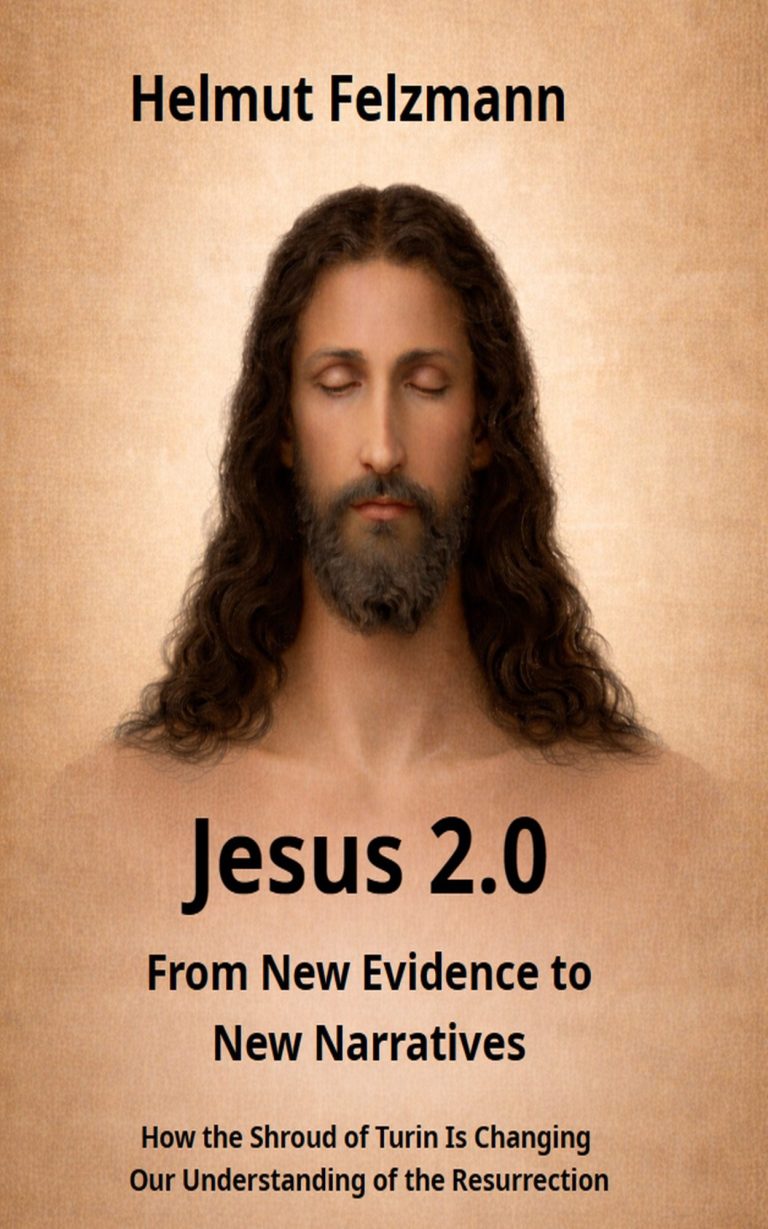
Jesus 2.0
From New Evidence to New Narratives
How the Shroud of Turin Is Changing Our Understanding of the Resurrection
Short Description
The first part of the book takes a fresh look at the credibility of the 1988 radiocarbon dating and reexamines the authenticity of the Shroud of Turin in light of historical and scientific evidence.
At its core lies a forensic investigation: Which traces point to a living body—and which to a corpse?
Under what conditions can the image on the cloth be explained as a natural process?
The last section of this part explores the theological implications:
What does this reassessment mean for the Christian understanding of the Resurrection?
Can the dialogue between faith and science be reopened?
The second part of the book tells the story of Jesus from a radically new perspective.
In The Memoirs of Judas, the relationship between Judas and Jesus unfolds as more personal, more conflicted, and more existential than in the Gospels.
Friendship.
Hope.
Doubt.
Betrayal.
And a story that does not end at the cross.
The historical analysis opens the door.
The novel takes you through it.
A New Perspective Begins Here
- Readers interested in the Shroud of Turin and its scientific analysis
- Christians open to reexamining foundational beliefs
- Skeptics who follow evidence wherever it leads
- Anyone drawn to the intersection of history, science, and faith
Jesus 2.0
Get a first impression of both parts of the book
Learn more about Dr. Helmut Felzmann and the background of this work.
See how early readers experienced Jesus 2.0
Before You Decide
This book is not written to confirm what you already believe.
It is written to confront you with evidence—and let you draw your own conclusions.
Note:
The book is currently available to read for free with Kindle Unlimited.
The book is also available in English.
This book explores the Shroud of Turin evidence, its authenticity, the carbon dating controversy, and the forensic analysis of the image. It examines whether the Shroud of Turin shows a dead body or a living body and what this could mean for the historical understanding of Jesus and the resurrection.