The Fourth Wake-Up Call – What the Shroud of Turin Means for Church and Faith
The Three Great Wake-Up Calls of Humanity
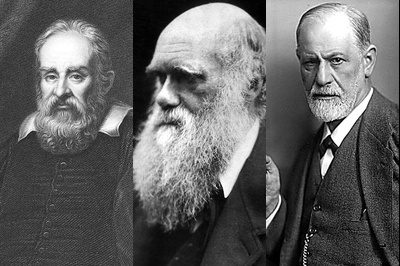
Galileo Galilei - Charles Darwin - Siegmund Freud
The psychoanalyst Sigmund Freud spoke of the great “wounds” to humanity’s self-image:
1. Galileo Galilei
The Earth revolves around the Sun – not the other way around. Humanity loses its central cosmic position. Religion reacts defensively, often in tension with scientific insight.
2. Charles Darwin
Humans are the result of evolution. No metaphysical exception, but biologically related to all living beings. This challenges the idea of a unique creation.
3. Sigmund Freud
The ego is not master in its own house. Unconscious processes shape thinking and action. This realization calls into question traditional notions of human autonomy.
The Fourth Wake-Up Call: Jesus Survived
The central thesis of this website – and of the book Jesus 2.0 – is:
The forensic findings of the Shroud of Turin suggest that Jesus may not have been dead in the tomb in the sense traditionally assumed.
If this were true, the foundation of classical resurrection dogma would need to be reconsidered. Not as a denial of faith, but as an invitation to reinterpret it.
The Shroud is not primarily a relic of a supernatural event, but a silent indication of a real, historical Jesus – and of a different understanding of his message.
This wake-up call does not concern only the interpretation of a single artifact. It affects the entire model of how religion understands reality. Science thus calls the Church to a radical theological paradigm shift.
The historical Jesus becomes visible again: not as a distant object of belief, but as a living reality whose message can be reinterpreted in the light of scientific insight.
What Does This Mean for the Understanding of Resurrection?
At the center of the traditional liturgy stand the sacrifial death of Jesus Christ and his resurrection – understood as a real, physical overcoming of death. Through this, original sin is overcome and redemption becomes possible.
The consequence was a strong theological fixation: salvation comes through belief.
A re-evaluation could lead to a different perspective. Dogma would have to be reconsidered, or at least reinterpreted, in light of new insights.
History itself does not change. But its interpretation can.
This reveals a different image of Jesus:
Not as a figure of dogmatic elevation – but as a radical teacher, as a conscious human being, as an existential provocateur.
Responsibility Instead of Veneration
If Jesus was not simply “resurrected,” the focus shifts:
- Not redemption, but personal development
- Not belief, but conscious awareness
- Not metaphysical dependency, but inner maturity
The question is then no longer:
“Do I believe in him?”
But:
“Do I live from the same source?”
Mt 13:44–46), Jesus describes the Kingdom of God as a treasure in a field and as a precious pearl.One finds it by chance, the other searches for a long time—yet both recognize at the same moment the true value of what they have found. For this, they sell everything they own.
“Selling everything” is not a religious achievement or a sacrifice, but the spontaneous consequence of insight. Whoever recognizes what truly matters no longer clings to what is secondary. The Kingdom of God is not earned, but recognized—and therein lies its liberating power.
Jesus is thus describing an inner transformation: It is not renunciation that leads to the Kingdom, but rather the Kingdom that puts everything else into perspective. It is the joy of discovery, not the pressure of obligation. It is less an event than a gentle reminder that the spirit is opening itself once again to the truth.
Insight brings freedom.
Freedom enables love.
Religion and Science – A New Relationship?
Albert Einstein wrote in 1954 in Science and Religion: “Science without religion is lame, religion without science is blind.”
Since the Enlightenment, there has effectively been a division of roles: Science explains what can be measured. Religion deals with what cannot.
The result is often a tension in understanding.
People accept biological reproduction – and at the same time profess the virgin birth. Sunday belief and everyday reality remain separated. But truth cannot be divided.
If religion and verifiable knowledge contradict each other, it is not reality that needs correction, but our framework of interpretation.
If consciousness is not a product, but the foundation of reality, then physical processes would not be the cause, but the expression of deeper underlying structures.
Human beings would then be understood primarily as beings rooted in consciousness – embedded in a larger field of awareness.
Religion would no longer be a system of beliefs, but a path of experience, integration, and transformation.
Science, in turn, would need to expand beyond a purely materialistic paradigm.
The Fifth Wake-Up Call: Consciousness as the Ground of Reality
The Shroud of Turin in the Context of These Questions
The Shroud of Turin confronts us with questions that cannot be answered by natural science alone.
It is a case in which not only the findings themselves matter, but the perspective through which they are interpreted. And this is precisely where its significance lies: Not in providing final answers, but in opening new ways of understanding.
Perhaps its true significance lies precisely in bringing both perspectives into dialogue with one another anew.
But when our understanding of the events of that time changes, it affects not only theology or science.
It also affects the stories through which we recount these events.
New facts require new stories.
What emerges from the investigation of the Shroud of Turin is more than a collection of scientific observations.
It is a picture that only becomes complete when evidence and narrative are brought together.
In Jesus 2.0 – From New Evidence to New Narratives, this connection is explored in a unique way:
The first part presents the scientific analysis – tracing the forensic, historical, and physical evidence surrounding the Shroud.
On this foundation, the second and much larger part unfolds as a novel: “The Memoirs of Judas.”
Told from Judas’s perspective, a new image of Jesus emerges – more personal, more complex, and more unsettling than the traditional accounts suggest.
Friendship becomes discipleship.
Hope turns into doubt.
Judas acts – and breaks under the weight of what he has set in motion.
But his story with Jeshua does not end there. What results is not just a new interpretation, but a different way of approaching the story itself: not only through analysis, but through experience.
Where Evidence and Story Become One
What Readers Say
On the nonfiction section:
“I can’t stop reading. More gripping than any thriller—and at the same time scientifically sound and easy to follow. Thank you for this book!”
On the novel:
“Wow—what a book! Experiencing Jeshua from this perspective was both exciting and enlightening. It moved me deeply—and continues to resonate with me to this day.”
→ Return to the Shroud of Turin Analysis