STURP 1978 – The Most Comprehensive Scientific Analysis of the Shroud of Turin
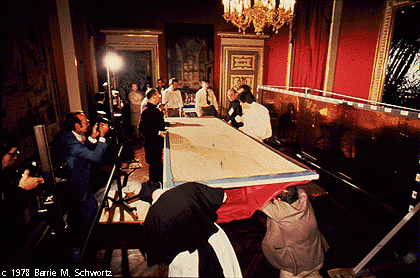
STURP-Examination in Turin © STERA
In 1978, the Shroud of Turin was subjected for the first time to a systematic scientific examination as part of the Shroud of TurinResearch Project (STURP).
Around 30 scientists from seven different disciplines – including physicists, chemists, medical doctors, and forensic experts – analyzed the cloth for five days, working around the clock directly in Turin.
The objective was clear:
Is the Shroud a medieval work of art – or a real historical object with an image formation that remains unexplained?
To this day, STURP is considered the most comprehensive interdisciplinary investigation of a religious artifact in the 20th century.
Key Findings of the STURP Investigation
After five years of analysis, the scientists published their conclusions: The image is not a painting.
- No pigments or paint particles were found that could account for the image.
- The bloodstains contain hemoglobin and show chemical reactions consistent with serum albumin.
- The image depicts a real man who had been scourged and crucified.
- The mechanism by which the image was formed remains scientifically unexplained.
This made one point clear: The Shroud of Turin cannot be explained as a simple medieval forgery.
Raymond N. Rogers – The Chemist Behind the Analysis
The American chemist Raymond N. Rogers was responsible for the chemical investigations within STURP.
He arrived in 1978 as a skeptic. His initial assumption was straightforward: if the image had been painted, this should be easy to demonstrate. However, the analyses contradicted this expectation.
Rogers examined microscopic samples obtained from the surface of the Shroud using specialized adhesive tapes. He analyzed:
individual linen fibers
blood components
surface alterations
possible pigment residues
foreign particles
Over several decades, he continued to study these samples in his laboratory. His approach was strictly chemical and analytical, not theological.
In 2008, his work A Chemist’s Perspective on the Shroud of Turin was published posthumously. It is still regarded today as a standard reference for the chemical analysis of the Shroud.
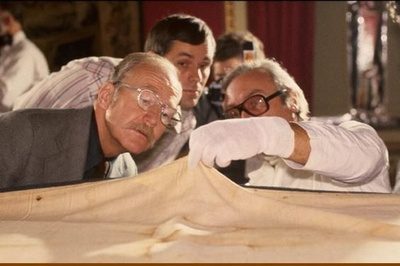
Raymond N. Rogers (left) in Turin © STERA
Radiocarbon Dating (C14) and Open Questions
After completing their investigations, the STURP scientists recommended:
a radiocarbon dating (C14)
24 additional in-depth analyses concerning the material and image formation
In 1988, a radiocarbon dating was carried out, which dated the linen to the Middle Ages. However, the remaining recommended analyses were never performed.
Today, both the credibility and the results of the C14 dating are more controversial than ever.
Why STURP Is Crucial for the Authenticity Debate
Anyone who asks whether the Shroud of Turin is a forgery cannot ignore STURP. Because regardless of theological interpretations, a core scientific finding remains:
The image is not a conventional work of art.
- Its chemical structure differs fundamentally from known painting techniques.
- Its formation has not been reproduced to this day.
- The laboratory findings make it difficult to explain the Shroud using simple forgery hypotheses.
This brings the next key question into focus: How could the image have been formed?
Continue with → Image Formation