How Was the Image on the Shroud of Turin Formed?
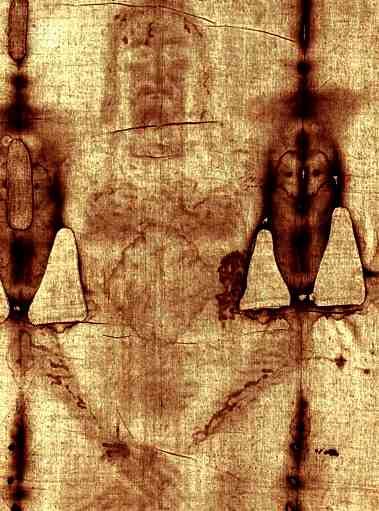
Nearly five decades after the STURP investigation, there is still no generally accepted explanation for how the image on the Shroud of Turin was formed.
For skeptics, the conclusion seems obvious: If the image cannot be explained, it must be man-made. The radiocarbon dating to the Middle Ages appears to support this view.
For believers, the opposite applies: Precisely because the image cannot be explained scientifically, it must have been formed by supernatural means – for example, during the resurrection of Jesus (an energy burst).
Both positions fall short.
Energy Hypotheses: Laser, Radiation, “Resurrection Flash
Among proponents of authenticity, there is broad agreement that the image may be related to some form of energy.
Two features support this idea:
- the high resolution of the image
- the presence of so-called 3D information
The closer the cloth was to the body, the darker the image appears at that point – fading at a distance of about five centimeters (2 inches).
From these variations in intensity, a three-dimensional relief can be calculated using computer analysis.
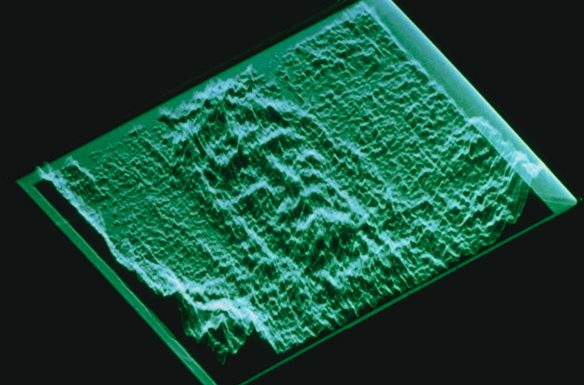
3D image derived from intensity data © STERA
The Italian physicist Paolo Di Lazzaro of ENEA demonstrated in experiments that an extremely short, high-intensity laser pulse can produce a superficial discoloration of linen similar to that of the Shroud.
However, this hypothesis raises significant problems:
Only individual fibers carry the image substance, while adjacent fibers often do not.
A dead body cannot emit such enormous amounts of energy.
High-energy radiation would be expected to leave characteristic microscopic damage within the fibers
Raymond Rogers: Why Radiation Can Be Ruled Out
Rogers examined image and non-image fibers under the microscope. His findings were clear:
- The image substance is located only on the surface of the fibers.
- The interior of the fibers is undamaged.
- There is no evidence of thermal or high-energy electromagnetic effects.
He concluded:
Radiation more energetic than green light would produce visible microscopic damage. Such damage is absent.
Therefore, the image cannot have been formed by high-energy radiation.
In addition, the image substance surrounds individual fibers – including on the side facing away from the body. This also contradicts the idea of a directed energy impulse.
In the image areas, only some fibers carry the image substance, while neighboring fibers often remain unchanged. This again argues against radiation, which would be expected to affect all fibers uniformly.
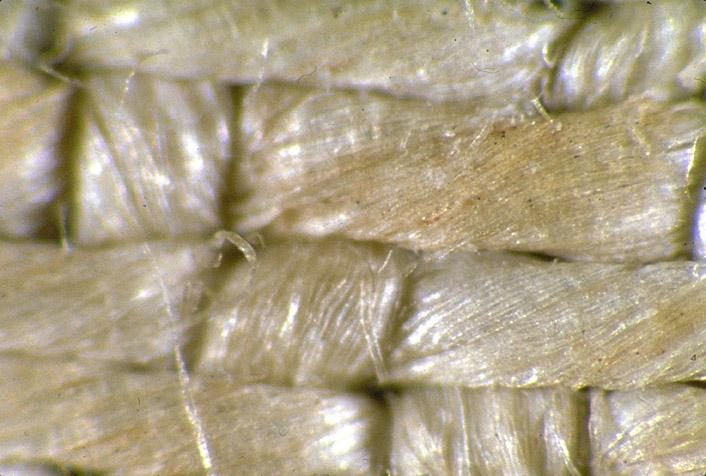
Microscopic detail of the linen. The image substance appears only on individual fibers. © STERA
Rogers’ Mild Reaction Hypothesis
After years of analysis, Rogers proposed a different model:
The image was formed under mild conditions at room temperature through a chemical process that required time.
He observed that linen fibers are coated with a thin layer of carbohydrates, likely residues from ancient textile processing. This layer appears yellowed on image fibers.
His hypothesis: Gases released from the body – for example through early decomposition, perspiration, or burial ointments – reacted with this carbohydrate layer. Differences in gas concentration could have produced the variations in image intensity.
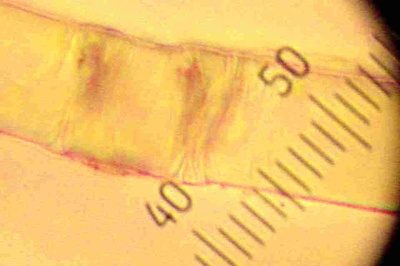
Microscopic detail of a single image fiber showing the yellow discoloration of the surface layer. © STERA
One objection remains
The small distance between body and cloth would likely have produced a relatively uniform gas concentration. One would expect a diffuse stain rather than a highly detailed image.
Rogers acknowledged that additional – still unknown – factors must have played a role.
Body Heat as a Possible Factor
A living body continuously emits heat (infrared radiation). Temperature decreases with increasing distance.
Chemical reactions proceed faster at higher temperatures.
If the Shroud lay over a warm body, the following could apply:
- The closer the cloth to the body, the higher the temperature
- The higher the temperature, the faster the chemical reaction
- The faster the reaction, the stronger the discoloration
This results in an intensity gradient – exactly what is observed on the Shroud.
As early as the 1980s, Rodney Hoare demonstrated experimentally that a living body can project a heat image onto a cloth placed over it – resembling the image on the Shroud.
This may also explain the image on the back.
Not only distance, but also local temperature differences – for example due to inflammation or wounds – could influence the reaction.
Injured areas may be warmer than surrounding tissue, for example in cases of fever. His line of reasoning suggests a radical implication:
The image may not have been formed by a dead body, but by a living one.
Is a Pardigm Shift Necessary?
The philosopher of science Thomas S. Kuhn introduced the concept of a “paradigm shift” in 1962.
According to Kuhn, science operates within certain basic assumptions. When observations cannot be explained, at first hypotheses are adjusted – not the underlying paradigm.
In Shroud research, the assumption of a dead body has so far remained unquestioned.
But if hypotheses within this framework fail, a simple question arises:
Could the fundamental assumption itself be wrong?
The hypothesis of a living body would represent a fundamental paradigm shift.
Such a hypothesis must, of course, be tested against all other evidence – especially the forensic findings.
And this is where the most surprising observations begin.