Was the Man on the Shroud Alive or Dead?
Many people approach the Shroud of Turin from a religious perspective. For believers, it is a fascinating artifact: a visual counterpart to the Passion narratives and thus a silent confirmation of faith.
In fact, the Shroud shows a man who was scourged and crucified and then laid in a linen cloth. The Gospels report that Jesus was wrapped in linen and placed in a rock tomb. This is commonly understood to mean that he was dead.
If the possibility is considered that Jesus may have survived the crucifixion, central doctrines are affected: Passion, redemption, resurrection. This perspective is therefore often rejected outright – as theologically incompatible or as a “medical impossibility.”
But the decisive question is not: What is theologically acceptable?
The question is: What do the traces on the cloth actually show?
The hypothesis of survival is not a theological issue. It is primarily a medical-forensic question.
If the Shroud is authentic, then it is not merely a religious symbol, but above all a medical object. And such objects are subject to scientific analysis.
From a scientific perspective, the following applies:
A person who has actually died does not return to life. If a revival occurred, then the person in question could not have been biologically dead.
The alternative is therefore clear:
- Scenario A: The cloth shows a corpse.
- Scenario B: The cloth shows an unconscious, but still living person.
These two scenarios can be evaluated on the basis of the traces.
A Forensic Core Question
Forensic Assessment of a Horizontal Blood Pattern
Until the 1990s, this question was rarely addressed. Death was simply assumed.
One of the first documented counterarguments comes from Rodney Hoare, who in 1984 presented photographic enlargements to forensic pathologists in London – without providing theological context, but solely for medical evaluation.
The result was surprising: The wounds are located in a zone that is not immediately lethal.
According to current standards, such a condition would more likely lead to a deep coma – not necessarily death.
A similar conclusion was reached independently by Prof. Bonte, then head of forensic medicine at the University of Düsseldorf. He was shown an image of the side wound without any background information.
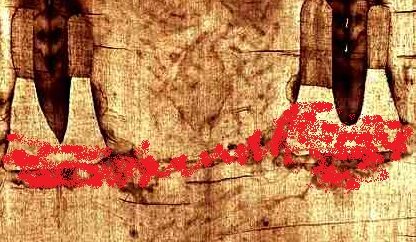
Lower back – blood from the side wound highlighted in red
The Side Wound
The blood appears to have spread through capillary action to both sides, extending up to about 20 cm across the body.
This means that blood must also have flowed beneath the back. This is only possible if fresh, non-coagulated blood continued to flow over a longer period of time.
Bonte’s analysis:
A horizontal blood pattern cannot be explained in the case of a corpse. It presupposes an active blood circulation.
The position of the wound – at the highest point of a body lying on its back – argues against the simple outflow of larger quantities of blood due to gravity.
Thus, the question was formally raised:
If the lance wound was located at the highest point of a body lying on its back, then, according to this interpretation, it would have been impossible for blood to flow out of the body solely due to gravity.
Arguments for an Established Death
Believing forensic experts – often with a Christian background – argue:
- The injuries would not have been survivable.
- There was no modern intensive care.
- A Roman execution squad would have carried out its task reliably.
These objections must be taken seriously. However, they do not replace an analysis of the actual traces
Indications of Risiudal Vital Funktions
- No clear pattern of pronounced rigor mortis
- Absence of signs of decomposition
- Blood flow patterns at the backs of the hands, implying blood pressure
- Multiple penetrations of the cloth in the area of the foot wounds
- Significant bleeding from the side wound with capillary flow beneath the back
Thumb position suggesting ongoing muscle contraction
None of these points is conclusive on its own. Taken together, however, they form a pattern that is difficult to dismiss.
Implications for Image Formation
The assumption of a still living body opens a sober, scientific perspective on image formation.
A metabolically active, warm organism differs fundamentally – both physically and chemically – from a corpse.
This creates at least a theoretical framework in which the image formation could be explained without resorting to a singular miraculous event.
Whether such a process can be experimentally reproduced remains an open – but in principle testable – question.
Conclusion: Weighing Probabilities
Absolute proof does not exist outside formal systems such as mathematics. Forensic science works with evidence, probabilities, and plausibility.
The current state of the evidence allows for a cautious assessment:
It appears more plausible to assume that the man in the cloth was still alive than that he was already dead.
his evaluation ultimately remains individual. In the book Jesus 2.0, the relevant evidence – including counterarguments – is presented systematically using images and forensic assessments.
The aim is not to impose a dogmatic conclusion, but to provide a transparent basis for judgment, enabling readers to form their own view.
This assessment does not replace a theological decision. It merely describes the current state of forensic plausibility analysis.
The further question is therefore not only whether the crucified man lived – but who he was.
And this question leads to the next step of the investigation: Was the man Jesus of Nazareth?
Continue with → Was it Jesus?