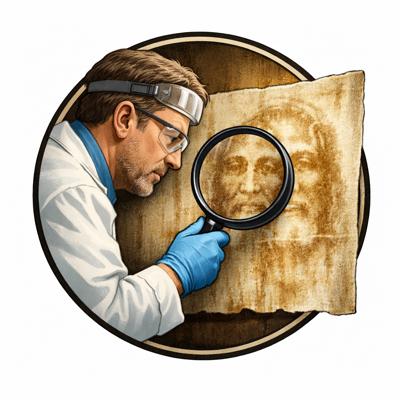
Was It Jesus? The Identity Question of the Shroud of Turin
Did the cloth cover the historical Jesus of Nazareth – the man whom Christi
ans venerate as the risen Christ?
Or does it represent another crucified individual from the same period?
This question cannot be answered theologically, but only through evidence. The decisive factor is a simple test of plausibility. A “false Jesus” would have to match all relevant characteristics as well. Even a single clear contradiction with the transmitted accounts would rule out the identification.
If, for example, the legs had been broken – as was often practiced in crucifixions – the discussion would be over. But this is not the case.
With the exception of the disputed radiocarbon dating, there is no finding that clearly contradicts the biblical narrative.
General Indicators – Possibility of Authenticity
This level concerns the fundamental question of whether the Shroud could be the authentic burial cloth of a crucified man.
Crucifixion was abolished under Constantine the Great in the 4th century. An authentic burial cloth must therefore originate from an earlier period.
The anatomical precision of the wound patterns corresponds to modern forensic findings (nails in the wrist area, realistic blood flows, differentiated body positions). Several forensic experts from different countries independently concluded that the image depicts a real crucified man – not an artistic construct.
The image shows no consistent pigment layer, no brush traces, and no painterly structure. Isolated pigments can be explained by later contact or copying practices.
The blood traces were identified as human blood by Prof. Baima Bollone. Notably, the blood is typically located beneath the image layer – in a forgery, the blood would have had to be applied before the image.
The image formation does not follow an optical projection principle (such as photography), but correlates with the distance between body and cloth – explaining the known 3D properties.
These indicators do not mathematically exclude a medieval forgery, but they make it highly difficult to explain.
Specific Indicators – Evidence for the Identification as Jesus of Nazareth
At this level, the evidence converges on a specific historical figure: Jesus of Nazareth.
Scourging: The distribution of the wounds corresponds to a Roman scourging with a flagrum taxillatum (weighted whip). The injuries affect the back, chest, and legs, and indicate a fully unclothed body.
Crown of thorns: The numerous puncture wounds on the head do not correspond to a classical crown, but rather to a cap-like arrangement of thorns – consistent with the mockery as “King of the Jews.”
Side wound: The wound in the area of the right 5th–6th rib corresponds in size and form to a Roman spear wound. The described features correlate with the account in the Gospel of John (“blood and water”).
Burial in haste: The body appears to have been wrapped in a linen cloth without prior washing – plausible in the context of an approaching Sabbath.
Honorable burial: A rock tomb burial implies influence or advocates – as described in the Gospels with Joseph of Arimathea. Victims of crucifixion were typically thrown into mass graves.
Conclusion: The Combination of Unique Features Leaves Little Room for Alternatives
Taken together, the evidence forms a profile that is historically highly specific:
- Roman-style scourging
- Crucifixion without broken legs
- Injuries consistent with a crown of thorns covering the entire head
- A spear wound to the right side of the chest
- A hasty but honorable burial
- No signs of prolonged decomposition
- Later veneration as an image not made by human hands
Each of these features could be explained individually. Their combination, however, is extraordinary.
The decisive question therefore becomes:
- Is there a historically documented person who:
- was crucified in this manner,
- was mocked as “King of the Jews,”
- received a spear wound,
- was buried honorably in a rock tomb,
- left no signs of decomposition,
- and was later proclaimed alive by his followers?
The conclusion is left to the reader.
Beyond scientific and historical evidence, there is another line of inquiry that is often overlooked: the image tradition of Christianity.
Many researchers suggest that the face of the man on the Shroud influenced the depiction of Jesus from late antiquity onward